The Lotus Position in Anime And Manga
The Full Lotus position is a seated cross legged position employed in meditation practices throughout the world. In anime and manga it is often depicted incorrectly. But so far nobody on the internet has seemed to notice.
The Full Lotus position has a rich cultural background, many purposes and benefits, and is sometimes depicted in anime and manga… Though rarely in the traditional way. This is especially true in the Shonen (Young Boys) genre, such as in Dragon Ball.
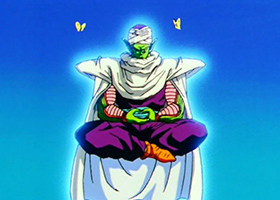
In Dragon Ball there are martial artists and individual styles of martial arts based cultivation practices. Some of the practices involve meditation. For example, there are scenes where Piccolo meditates in a cross legged position as he levitates above the ground using his own internal energy. Meditation is the primary way in which Piccolo increases his power level. In this practice he strengthens and refines his supernormal abilities. While Yamcha, Tenshinhan and Chaozu engaged in North Kaio’s special training methods during the Saiyan Saga, Piccolo only sat in meditation. Yet in this simple process he became more powerful than all of them.
But the seated position that Piccolo maintains is not the proper Full Lotus. Instead it is a general cross legged position, with one ankle loosely crossed in front of the other. He supposedly sits like this for hours at a time.
However, it is nearly impossible to sit like this for extended periods of time. The body is too tense and a practitioner cannot enter into tranquility. The Full Lotus is a remedy to this problem.
What is the Full Lotus?
What exactly is the Full Lotus position and what makes it different from a regular cross legged sit?
9 Divine Aspects of Dragon Ball Z
Have you noticed divine aspects in Dragon Ball, Dragon Ball Z or GT? How about similarities between Goku and a certain spiritual teacher? Or perhaps the way in which good always triumphs over evil?
If you did notice these it’s because they’re in there! If you didn’t, then read this to learn more.
Here are 9 specific ways in which the divine shows up in Dragon Ball:
1. Mythically Buddhist Origin’s
Loosely based on Journey to the West, a Chinese tale of pilgrims on a holy quest for the Buddhist sutra’s of India, Dragon Ball is rife with spiritual references of an East Asian perspective. Sun Wukong (Japanese: Son Goku), The Handsome Monkey King, is the character that Goku is based on, and Sun Wukong himself is most likely based on Hanuman, the Indian deity and warrior.
King Enma, lord of the afterlife, is based on a Chinese and Japanese deity that weighs the amount of virtue and karma on a person’s soul to determine where they should be sent, Heaven or Hell, and we find that same character in Dragon Ball.
There are a multitude of other examples and references to the Buddhist stories that Japanese children like Akira Toriyama (the creator of Dragon Ball) would have been taught while growing up.
2. Heaven and the Afterlife
Heaven plays a big part in Dragon Ball Z as Goku spends a lot of his time up there!
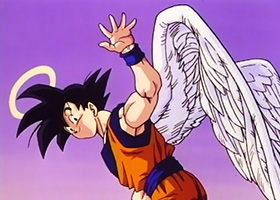
After sacrificing himself to save his son’s life (and the planet himself) Goku is sent to the afterlife where his soul is judged by King Enma. The King determines that he is pure hearted enough to ascend up to Heaven, but Kami requests a special favor of the King and asks for Goku to be trained by North Kaio, Lord of the Northern Galaxy. King Enma agrees and allows Goku to keep his physical body, now tricked out with a super spiffy halo. continue …
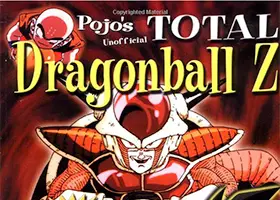
Dragonball Book Review – Pojo’s Unofficial Total Dragonball Z
Pojo’s Unofficial Total Dragonball Z
At the time of its publication (2000) Pojo’s Unofficial Total Dragonball Z was the best DBZ book on the market. Even now, in 2007, it’s not so bad. It’s not quite a book so much as a glorified magazine, but it’s a worth a read if you need to read everything DBZ related. If not, I would recommend the newer version, Pojo’s Unofficial Absolute Dragonball Z, which came out three years later, simply because it’s the fresher fish in the market.
Aside from its own merits, this book serves as a walk down memory lane of the year 2000 in American anime and television based pop culture. It captures the influence that Dragonball had on the American telescape with its success on Cartoon Network’s Toonami and Adult Swim, the release of a Collectible Card Game, VHS and DVD obsessions, and video game imports all the rage. continue …