Dragon Ball GT Music – Composer Mark Menza Interview Part 2
Welcome back to Part 2 of my interview with Mark Menza, composer of FUNimation’s Dragon Ball GT. We are continuing from Part 1.
In this interview you will learn about Mark’s perspective on Bruce Faulconer, hear his thoughts on the Dragon Ball fandom, and discover the origins of the Dragon Ball GT rap intro!
That’s right, the full explanation for the GT rap intro!
You’ve been waiting 9 years to hear the answer to this great mystery surrounding the Dragon Ball GT dub, so don’t miss it!
continue …
Dragon Ball GT Music – Composer Mark Menza Interview Part 1
American Dragon Ball GT. What do those words immediately make you think of? If it’s the controversial rap music intro, then today you’re in for a treat because I recently interviewed Mark Menza, the composer of FUNimation’s Dragon Ball GT.
Today you’ll discover how Mark earned the job working on GT, the challenges he faced, his musical influences, and what he thinks about Dragon Ball fans.
This article is for the hardcore Dragon Ball fan that wants all the details they’ve been missing since GT went off the airwaves.
You’ll learn exactly why GT ended up the way it did and discover the true story of GT’s development.
Dragon Ball AF Explained
Dragon Ball AF. You hate it, you love it, or maybe you’ve never heard of it. In any case, I doubt you know the full story.
It’s a truth that Dragon Ball fandom is and always has been intense. Regardless of their preferred version, Dragon Ball fans absolutely love their Dragon Ball.
Just before Dragon Ball GT concluded its original television run in Japan in 1997, a rumor spread about a new official series called Dragon Ball AF. Fans wanted the series to continue.
The only problem is that it was never true.
And you might suppose we could end this article right here. But as with everything involving Dragon Ball and its impact across the world, there’s a lot more to the story.
Dragon Ball AF was originally the creation of an unknown fan that evidently had a strong desire for a fourth Dragon Ball anime series.
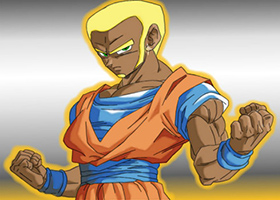
A single image appeared on the web of a hypothetical Super Saiyan 5 Goku with a “Dragon Ball AF” logo on it, and from there it spread like wildfire.
The rumor grew gradually over the years and took on a life of its own, spawning many fan creations, illustrations, videos, episode listings, action figures, and even high quality fan manga based on the collective rumors.
For example, who is this guy fighting Goku?
Images like this confused the heck out of new Dragon Ball fans. And those who circulated lies about Dragon Ball AF preyed on the gullible nature of fans who simply wanted to see more of their favorite characters.
The desire for a new Dragon Ball series is so strong that even today the rumor is still actively spread that Dragon Ball AF is the next official series from Toei, and that the videos and images “leaked” on YouTube will arrive in “the next year or two.” New fans continue to fall for it, and the cycle continues.
Despite all the time that it has been around, if you search online for an explanation of Dragon Ball AF, you will only find bits and pieces of info. A short wiki article here, some crudely Photoshopped images there, a guy saying it’s not real while another screams back that it is, followed by immature insults and a link to fan made manga. There are, maybe, two good sources on the topic. Unless you spend hours putting the pieces together, you’ll be confused or simply dismiss the whole thing outright.
Because of Dragon Ball Z Kai’s and Dragon Ball GT’s second syndication on TV, there is now a new generation of Dragon Ball fan looking to see what happens next.
With the realization that people are still being confused, I set out to discover the true story behind Dragon Ball AF and write the definitive article.
Along the way I found a captivating story to tell.
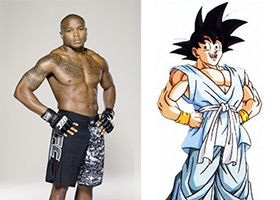
The Black Goku
Have you ever asked yourself if Goku is black?
When people ask about Goku’s race, they tend to think Asian or Caucasian.
That’s because Goku’s skin tone appears light, even though it varied throughout the series, especially in Dragon Ball GT when he had a darker tan.
Also because of his literary and actual origins in East Asia.
But back in the late 90’s and early 2000’s, American Dragon Ball fans started to connect with Dragon Ball and relate it to their own lives.
Some African American fans assimilated Goku and purposefully made him black, so as to better connect with their hero.
Today you’ll learn about this social phenomenon.
You’ll also see how FUNimation, the American dubbing company that licensed Dragon Ball from Japan, may have contributed to or capitalized on this trend, and how this then resulted in Americans further assimilating Dragon Ball into their lives.
Get ready to “Step into Da Grand Tour” of The Black Goku.
continue …
Marcus Brimage – DBZ and MMA Part 2
This is Part 2 of the Marcus Brimage interview about DBZ and MMA. Click here for Part 1 of the DBZ and MMA interview
DEREK: You stated that Dragon Ball Z is the greatest action anime of all time. Why do you feel that way?
MARCUS: Because, man! No fillers baby! They got straight to the point. The action!
They had one filler, and that was the Garlic Jr. Saga. Which wasn’t that bad! It was a nice little break, like 5 episodes, and then they got right back to Future Trunks and the Androids. They got right back on it.
And they had a little fun with Goku and Piccolo trying to learn how to drive, you know, that little bullshit, but for the most part Dragon Ball Z stayed the course, it always stayed focused on the action.
Marcus Brimage – DBZ and MMA Part 1
Dragon Ball Z is a martial arts epic brimming with legendary fights.
These fights have awed and inspired fans across the world. And there are some fans who become so inspired that they decide to pursue martial arts and make it their career.
I had the privilege of interviewing one of those inspired fans recently: Marcus Brimage, a Mixed Martial Artist who can currently be seen on Season 14 of The Ultimate Fighter (TUF) on Spike TV.
Here is Marcus’ introduction interview on the show.
This caught my attention and I decided to reach out to Marcus on Twitter. He agreed to the interview and the results were amazing.
We ended up talking for over an hour!
How and why did Dragon Ball inspire him? As an expert martial artist, what is his opinion on the fighting styles of Dragon Ball and Dragon Ball Z? How does spirituality play a role in his fighting? And did Dragon Ball influence his fighting style?
We also discussed his time growing up in Alabama and his desire for a greater life. His early experiences getting tough love from his MMA instructors. And the superiority of Dragon Ball over other action anime.
Not to mention another comment by Marcus for all of the Naruto fans out there!
*Warning that this interview contains occasional swear words.
*Warning that this interview contains violence and mixed martial arts content.
*Warning that this interview contains Dragon Ball spoilers because Marcus and I are super-fans and discuss the series in detail.
That’s right, kids!
So without further ado, here is The Dao of Dragon Ball’s interview with Marcus Brimage, a mixed martial artist and Dragon Ball fan!
The Kiai in Dragon Ball
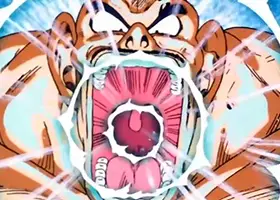
In Japanese martial arts, the Kiai (気合) is commonly thought of as a loud yell that coincides with an attack. But it’s actually a method of breathing, and is so much more than a simple scream.
In Dragon Ball, the Kiai is taken to an extreme. While drawing upon ancient martial arts legends, Akira Toriyama gives a visual appearance to what used to be invisible. He also illustrates what the Kiai could be capable of when used by a supernormal martial artist.
Toriyama’s creation has inspired a lot of people to practice martial arts, and the Kiai is an integral aspect of eastern martial arts, so it’s important to understand.
From super powerful punches to shields of energy, let’s take a deeper look at the Kiai in Dragon Ball.