Dragon Ball Kai FUNimation QA at AX

Anime Expo 2011 Funimation Booth SignDuring the Anime Expo 2011 I dropped by the FUNimation booth for an impromptu Q & A with Lance Heiskell, FUNimation’s marketing director.
The questions were completely spontaneous, and so were his replies; very casual and unofficial.

“How is Dragon Ball Kai doing so far on American TV?”

According to Lance, “Ratings have done very well, and new episodes will resume in fall 2011.” Reruns are currently airing on Nicktoons.

“How about the censoring of the show? This is a sensitive issue for a lot of Dragon Ball fans.”

Lance said, “It has to be edited on TV because it’s a commercial network.” He said shows have to appeal to marketing standards and demographics, otherwise advertisers won’t buy ads. Referring to the 4Kids channel version of Kai, he added that, “4Kids is even more edited.”

“What is FUNimation planning to do about the Kenji Yamamoto music scandal?”

Lance said he is fully aware of the scandal; however, “It’s a sensitive issue. I can’t comment.”

For those who do not know, Kenji Yamamoto was the composer for Dragon Ball Kai, and he got in trouble for creating music that was too similar to other musicians and film composers. His music was pulled from the Japanese version’s last few episodes and replaced with the original DBZ score, and American fans waited to see how FUNimation would respond.

When pressed further, Lance went on to say that he knows how FUNimation is going to handle the situation, but making comments would be disrespectful to the license holders involved, which include Toei in Japan.

Then we talked about The Dao of Dragon Ball book and how he may be able to help.

That’s it! Short and sweet.

Editors Chosen

Mr Shu the Tutor

Mr. Shu. Gohan's Tutor

Hey everybody. I made a decision that will take the book one step closer to completion. I hired a pair of professional editors.

The first is Marta Tanrikulu at TanMar Editorial Services, as the developmental editor. It’s her job to help shape and focus the book, restructure it accordingly, and cut whatever gets in the way of the primary message. Which, by the way, is this:

The message of The Dao of Dragon Ball is to convey the true history of the Dragon Ball series, its connections to ancient Indian, Chinese and Japanese cultures, Hollywood pop culture, futuristic science fiction, and the underlying meaning of life discovered through spiritual cultivation via the martial arts.

The second editor is Elissa Rabellino at StyleInSites, and she is the copy editor. After I finalize the content with Marta’s guidance, Elissa will help refine the prose and deftly say more with less.

Both editors are from the San Francisco Bay Area. They each had an interest in anime or manga as well as a ton of experience in their craft. I imagine that their expertise will enable the book to reach the next level.

It required several weeks of interviews and a lot of soul searching to make the final decisions, so here’s hoping for the best!
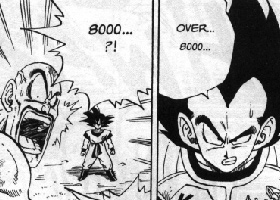
Over 9,000! Bonus Item Just Added to DBZ Book

It is Over 8,000 in the original comic.  Yep.  Read the report to find out more.

Nope. It really is Over 8,000 in the original comic. Read the report to find out more.

I’ve put together a brand new special report that will help you learn all the details on the Dragon Ball internet phenomenon “Over 9,000!” that is found all over the web, and I’m giving it away for free with The Dao of Dragon Ball book.

Included in this over 9 page bonus item is an in-depth analysis of the pop cultural history of “Over 9,000!” and it’s connection to the Japanese DBZ source material as well as its connection to ancient Chinese, Indian, and Japanese cultures.

The report cannot be found elsewhere and is yours free just by giving The Dao of Dragon Ball a shot. If you decide the book isn’t for you, then you still get to keep your bonus item.

You can pick up a copy of the report at the main DBZ Book website.

Perceived Value and True Masters

Goku Half & Half

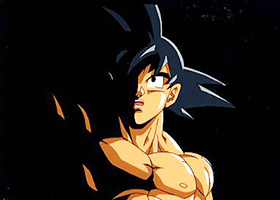
Goku Stands in the Shadows

A visitor to the site wrote to me recently asking, “By charging people money for this information aren’t you undermining everything it stands for?”

That’s a forthright and important question.  It’s also one I’ve struggled with for years.

Truth be told, he meant no disrespect by the question, as he was coming at it from a Buddhist perspective of compassion which I completely agree with.

I’ve practiced Shaolin Gong Fu for 10 years, and have taught it for free ever since I was capable enough to do so. My family and friends have sometimes said I’m a fool to give it away for free, but for me, Shaolin Gong Fu is sacred.

Shaolin Gong Fu originates in Buddhism and is (or at least used to be) a martial art that can enable someone to attain the level of Arhat, as taught by Bhodidharma. To charge for that just seems disrespectful. Of course I can understand if it’s your business and livelihood. That’s a different situation.

It’s my understanding that the lower the level, the more complicated and expensive. A great way is simple and free. The only thing you lose is karma, and what you gain is priceless… how could someone put a price on eternal enlightenment? continue …

9 Divine Aspects of Dragon Ball Z

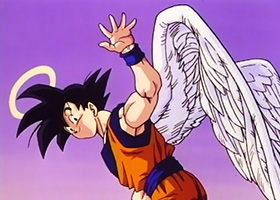
Goku with Angel Wings and Halo

Goku with Angel Wings and Halo

Have you noticed divine aspects in Dragon Ball, Dragon Ball Z or GT?  How about similarities between Goku and a certain spiritual teacher?  Or perhaps the way in which good always triumphs over evil?

If you did notice these it’s because they’re in there!  If you didn’t, then read this to learn more.

Here are 9 specific ways in which the divine shows up in Dragon Ball:

1.   Mythically Buddhist Origin’s

Loosely based on Journey to the West, a Chinese tale of pilgrims on a holy quest for the Buddhist sutra’s of India, Dragon Ball is rife with spiritual references of an East Asian perspective.  Sun Wukong (Japanese: Son Goku), The Handsome Monkey King, is the character that Goku is based on, and Sun Wukong himself is most likely based on Hanuman, the Indian deity and warrior.

King Enma, lord of the afterlife, is based on a Chinese and Japanese deity that weighs the amount of virtue and karma on a person’s soul to determine where they should be sent, Heaven or Hell, and we find that same character in Dragon Ball.

There are a multitude of other examples and references to the Buddhist stories that Japanese children like Akira Toriyama (the creator of Dragon Ball) would have been taught while growing up.

2.  Heaven and the Afterlife

Heaven plays a big part in Dragon Ball Z as Goku spends a lot of his time up there!

After sacrificing himself to save his son’s life (and the planet itself) Goku is sent to the afterlife where his soul is judged by King Enma.  The King determines that he is pure hearted enough to ascend up to Heaven, but Kami requests a special favor of the King and asks for Goku to be trained by North Kaio, Lord of the Northern Galaxy.  King Enma agrees and allows Goku to keep his physical body, now tricked out with a super spiffy halo. continue …

How to Change Others for the Long Term

Piccolo and Gohan - Master and Disciple

Piccolo and Gohan - Master and Disciple

You cannot force someone to change their heart.  The most effective long-term way to change others is to change oneself.

A common way to change someone is to directly inform, persuade, or force another person to align themselves with the way in which you desire them to change.  Barring any personal reasons for resistance, a willing and intelligent person will usually comply with the requirements of the request.

However, this direct method is primarily one of short-term change, because it is only the external behavior that has changed, not the underlying mindset or mechanisms that led to such a behavior.  Usually it will take 3 or more applications of such a method for it to ‘stick.’

In order for a person to truly change for the long-term they have to change their mindset, be willing to let go of their current notions or methodologies and make a conscious effort to change on their own behalf because it is what they want, for themselves and for others. continue …

A List of 9 Personal Values I will Live By

SSJ4 Gohan

SSJ4 Gohan

I recently started reading a book called The 10 Natural Laws of Successful Time Management, by Hyrum Smith.  So far it has been very engaging and informative.

I’m only on the 4th chapter, but I’ve already learned (or re-learned) some of the reasons why I procrastinate on my writing for the DBZ book, or any of my other various projects.

The essential point I’ve understood is that if I don’t prioritize my life according to my own intrinsic values, and live according to those values in everything I do, that I’ll never make progress on my projects or find satisfaction in my work.  In a larger scope…  I won’t find happiness in life.  So determining what my core values are is really important. continue …