Interview with Olivier Richard – Author of Akira Toriyama Book – Part 2
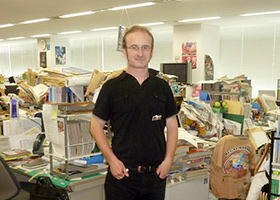
Welcome back to Part 2 of The Dao of Dragon Ball interview with Olivier Richard, the French author of Akira Toriyama – The Master of Manga.
In Part 1 Olivier and I discussed the French comic scene, his career of broadcasting Dragon Ball in France, and his personal comic book interests.
Today you’ll discover why Olivier chose to write about Akira Toriyama, hear what it’s like to collaborate with Shueisha, learn how he conducted interviews in Japan, and understand why Akira Toriyama truly is a master of manga!
Will there be an English translation? Does Olivier have insights into Toriyama’s personality? Read the rest of our discussion to find out!
continue …
Spirit Possession in Dragon Ball
Would you be willing to trade your soul to achieve worldly desires, or in exchange for more power? What about allowing your body to be controlled by God, or a demon?
In Dragon Ball, Akira Toriyama incorporates spirit possession as a way to propel character development and plot.
This article explores how Toriyama was inspired by ancient belief systems and spirit possession traditions.
continue …
Anger and Focus in Dragon Ball
Pain sharpens focus. Comfort dulls it.
Anger and pain narrow the mind. Compassion and tolerance broaden the mind.
Pain and anger drive one to take immediate actions. Comfort and pleasure pacify the mind to linger in non-action.
In Dragon Ball, villainous forces run amok. Different beings vie for power and control of planets.
Both the Guardian named Kami and North Kaio are passive deities, wrapped in idyllic comfort. They are supposed to protect the people within their domain, but most of the time they don’t do anything.
Placed above the living world in stations of authority, they look out with a broad view at the sentient beings below. Yet they are more dedicated to watching events unfold then changing them. They pass time with voyeurism.
They do not use their vast powers and supernormal abilities. Laws are in place that state how they can interact with the lesser beings. Thus, with restraint in their heart and a broad long term perspective that things will work out on their own, they do not act. They only lament the current state of affairs. The beings below are left to fend for themselves.
Goku’s life is uncomfortable. Whether under attack or in training, Goku is forced to become angry in order to ascend. Goku is a genuinely nice person, but when he is pushed to the limit he becomes filled with rage. He is a true spiritual warrior who directs short term anger in explosive waves.
There were only a couple cases in Dragon Ball when Kami became angry enough to act.
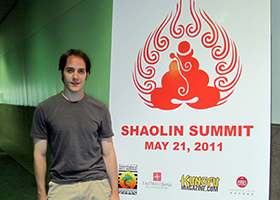
Shaolin Summit 2011
I attended the 1st Shaolin Summit as a reporter for The Epoch Times Newspaper and interviewed the Head Abbot of the Shaolin Temple, Shi Yongxin.
As a practitioner of Shaolin Gong Fu for over 12 years, and a student of East Asian studies, I thought it would be a lot of fun to go there, learn some new things and meet some good people.
The result was mixed.
Potara, Potala, Potaraka
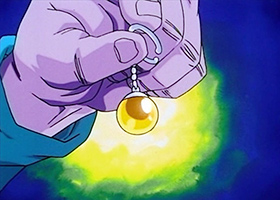
The Potara earrings are a device in Dragon Ball Z introduced near the end of the Majin Buu Saga. They allow one character to fuse together with another and increase their power level dramatically.
Everybody knows and loves them. But is there more to these simple earrings than meets the eye?
When all hope seems lost, Goku is given a Potara earring by Eldar Kai (Japanese: Rou Dai Kaioshin) that allows him to fuse with another person. They look like spherical ball earrings suspended by silver beads attached to a hoop that is placed in the earlobe.
Goku convinces Vegeta to wear one of the earrings while Goku wears the other. Immediately they are drawn to one another and their two bodies slam together, creating a new superhuman warrior.
The pair combined has the best of Vegeta’s pride and Goku’s rage, creating Vegetto, self-named after the combination of Vegeta and Kakarotto (Goku’s birth given Saiyan name).
According to Kanzentai.com, in The Super Exciting Guide: Story Volume, “On p.63 it describes the Potara fusion as being closer to multiplication rather than simple addition in the way it increases power. Supposedly, Vegetto’s battle power is equivalent to Goku’s battle power multiplied by Vegeta’s. Also according to the introduction of the Super Exciting Guide’s training section, all the information in it is based on data that was supervised by Toriyama, though we have no idea how extensive this supervision was.”
This makes Vegetto the strongest character in the entire manga.
But where did Akira Toriyama come up with the idea of Potara? What’s the story behind them?
1 Chapter Down, 1 More to Go!
The rough draft of Immortal and Invincible has been completed. This means that there is only 1 chapter of the book left to be written, (currently) titled Divine Combat.
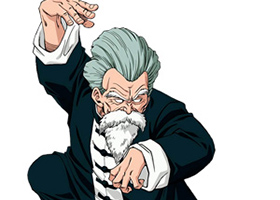
The Immortal and Invincible chapter discusses the practices of martial arts masters on their quest for immortality.It focuses on Daoist masters and sennin hermits, like Master Roshi (aka Jackie Chun).
The chapter measured in at 28 pages (at 11 pt font), so it may be many more in the actual book. Though of course it will be edited down and made more concise. Even so, that chapter was extremely difficult to write and I am glad the rough draft is complete.
Thank you to those who have written in with their support. I know you guys are looking forward to the book’s release. For those that are eager to read more about this chapter, here are the first 3 paragraphs of the rough draft:
“Dragon Ball is filled with martial artists that employ the use of supernormal abilities to do battle or heal the wounded. The characters fight against themselves, against those with ulterior motives, and in some cases against outright demons.
With the Ksatreya warriors and the path of the Vajramukti well established in Indian culture the concept of an invincible and noble warrior became intertwined into the martial arts on its voyage across nations. Spreading to both Western Europe and the Orient the draw of the martial arts and the spiritual path were adopted by various cultures. In this chapter we learn how the belief systems and cultural traditions of ancient China affected the creation of Dragon Ball in Japan. By the end of the chapter it will be very evident how Toriyama borrowed, was inspired by, or makes light of these beliefs in his comic.
The culture of ancient East Asia was a world of men and monsters, heaven and hell, and the cultivated spiritual warriors that overcame the demons on their path to immortality or enlightenment. The worlds of men, gods, and demons were interwoven. The life of a man was intricately linked to the heavens, and for those who walked the spiritual path of cultivation they would often experience demonic interference. The more one overcame these demons (whether internal or external) the more one would awaken their own potential. From this ideology sprang forth a culture of cultivation, and one such form of cultivation was the martial arts.”
Onward, to the next chapter!